
Expressing your love through flowers, gifts and dinner on Valentine’s Day is great, but identifying ways to connect and revisiting your shared values and experiences with your partner can offer long-term strategies for strengthening your relationship.
The Sound Relationship House
One of the most famous methods of couples therapy, the Gottman Method, is based on numerous research studies that discovered dynamics that contribute to successful long-term relationships (Gottman & Gottman, 2015).
I utilize Gottman’s method in my sessions with couples and recently collaborated on a psychoeducational group that utilized Gottman’s tenets to teach committed couples how to “reignite the spark” in their relationship. The strategies and insight from the group can be used for all couples as a way to re-connect so that less couples come into therapy in crisis. Based on a variety of research studies, John Gottman created the Sound Relationship House which is an analogy for understanding the seven components that contribute to secure long term relationships.
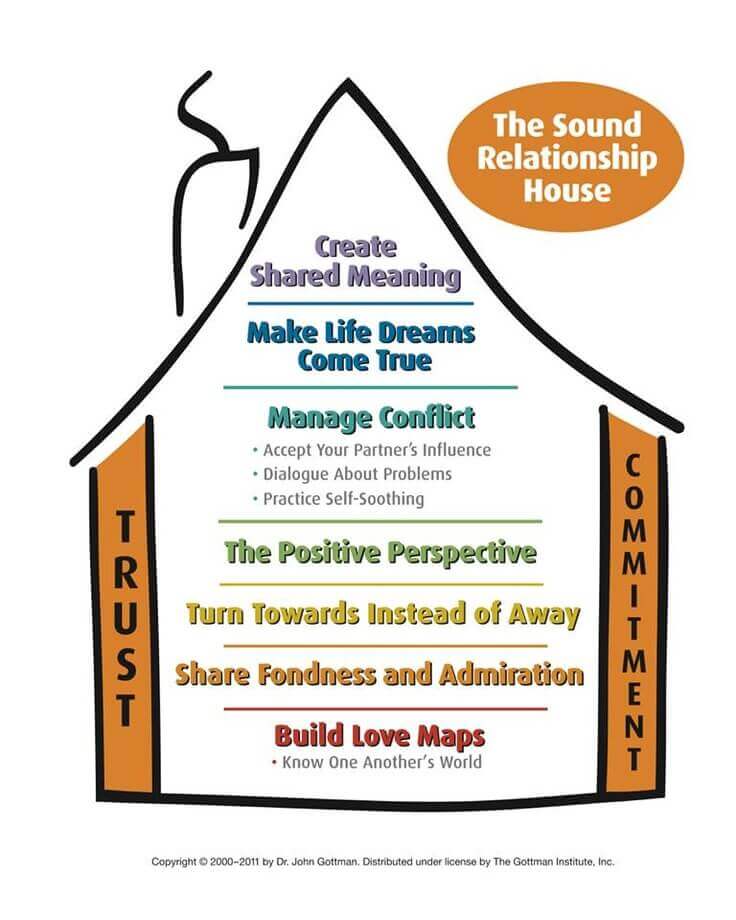
The first two levels of the house are building love maps and sharing fondness and admiration. Often, when I begin working with couples they are focused on conflictual communication or an issue where there seems to be no compromise. These couples find it surprising when I encourage them to step back and reconnect with one another before solely focusing energy into conflict.
However, according to the Sound Relationship House, having stronger levels allows for improved conflict management skills due to an underlying shared understanding between partners. Below is a brief overview of the two lowest floors and simple ways to strengthen both love maps and sharing admiration.
Building Love Maps
Building love maps is the first level of Gottman’s metaphorical relationship house (Gottman & Gottman, 2016). Love maps are a fancy phrase for the inner world of your partner. Building love maps means insight into both your partner’s present life experiences as well as the important experiences that have shaped them. Couples tend to build love maps when they begin dating due to asking one another new and exciting questions. However long-term couples get into routines where they are not asking new questions to understand how their partner’s inner experiences have evolved.
One of the ways I encourage couples to build love maps with one another is by sharing highs and lows. I encourage couples to shift away from merely asking, “How are you?” and instead asking “What was your high for today? What was your low?” By asking about highs and lows, a more developed story around challenges and successes each of you are experiencing can come to the surface. Additionally, this approach can lead to helpful feedback about relationship dynamics by asking, “What has gone well in our relationship this past week?” and “What have been some challenges this past week?
Another way to build love maps is by downloading a questions app. I often direct couples to download Gottman’s free app (https://www.gottman.com/couples/apps/) which includes both questions that build love maps, as well as, open ended questions, and date night questions. I’ve noticed couples feel excited to reconnect with their partner when new questions are in their repertoire.
Sharing Fondness and Admiration
The second level of the Sound Relationship House is sharing fondness and admiration. This means verbally sharing qualities you appreciate about your partner. For example saying “I appreciate how caring you are, for instance you cleaned out the fridge when I was dreading it. It shows me you really care about my needs.”
Illustrating appreciation through language is a powerful tool in staying connected with your partner. It allows them to have a specific understanding of behaviors you admire about them. The following copy of the positive adjective checklist can help couples to adjust to sharing appreciation openly - Positive Adjective Checklist
For more of an overview of the Sound Relationship house visit The Gottman Institute at www.gottman.com.
Alexia Kingzette, Licensed Marriage and Family Therapist Associate (LMFTA) Clarity Clinic NWI
References & Resources
Gottman, J.S., & Gottman, J. M., (2015). 10 Principles of Doing Effective Couples Therapy. W.W. Norton & Company Inc.
The Gottman Institute, (2022). What is the sound relationship house? Gottman Blog. https://www.gottman.com/blog/what-is-the-sound-relationship-house/
The Gottman Institute, (2022). Gottman card decks app: A relationship app from the Gottman Institute. https://www.gottman.com/couples/apps/
Positive Adjective Checklist: